Clean Up Crew
- caderboden
- Nov 13, 2023
- 5 min read

Updated: Jun 4, 2025
Engine: Unreal Engine 4/5
Genre: Simulation Adventure
Project: Collaborative
Job: Co-Project Manager, Co-Puzzle Designer, Co-Level Designer
Clean Up Crew is a simulation adventure game in which you play as a hamster and Voomba (Roomba). Your task is to combine forces to clean up the house and defeat the rats causing a mess.
My game design capstone group and I created this game in 2022, which we spent a whole semester creating. During this project, we aimed for a cute and goofy game that would get the player heavily invested.
Video/Trailer

We made the following game pillars before going into Unreal Engine:
- Atmosphere must be Goofy, Wacky, Ridiculous
- Game controls are easy to pick up and learn instantly.
- Stay true to what a Roomba is
- Take the player on a journey that leaves them emotionally invested in the Roomba’s and Hamster’s mission
Puzzle Design Process:
Among the five puzzles made in the level, I created 3 of them. These were the broom, toy collection, and building block puzzle. I felt that this project helped me grow a lot because I was familiar to making outside open world puzzles rather than inside puzzle.
Broom Puzzle:

When making this puzzle, the idea was to have a way for the player to go beyond just the floor to reach higher platforms with a dirty mess. In this case the soda cans left on the book shelf.

The hardest part in the process was getting the broom to be knocked down in the correct position, as no matter how much I tried it would keep either going through the floor or bookshelf. I was able to find the answer to this through the cinematic function in UE4. After it turned out really nice.
Toy Collection:
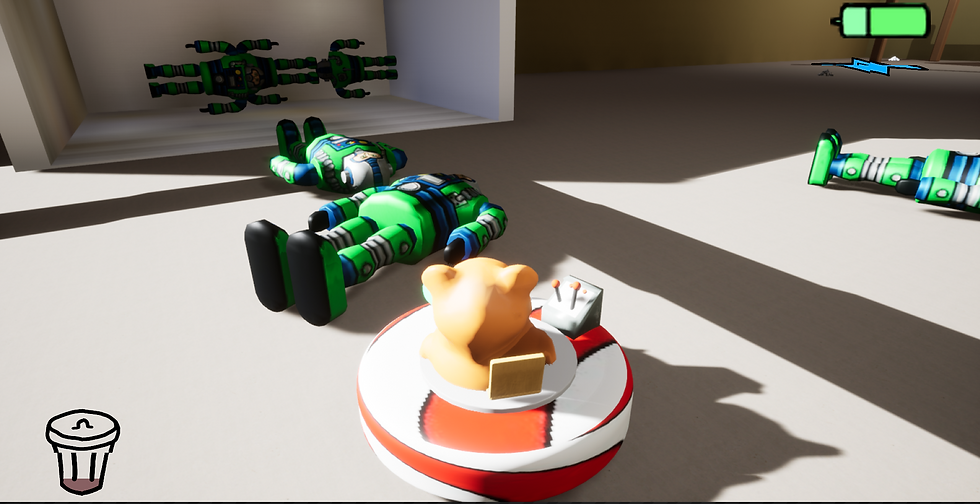
The toy collection puzzle was in my option one of the hardest puzzles to program in this game but it also made doing many other jobs in the game much easier. The biggest issue was finding a way that the box would read every static mesh and remove them upon entering the zone they

needed to be pushed into. I solved this issue by creating a destroy bounds box outside of the blueprint that would be in communication with the BP of of the box. The BP would read the static mesh spaceman that entered the area and would delete them and count it toward the amount of spaceman pushed into the puzzle until it reached 7 deleted spacemen. The most significant benefit but also toughest hurdle during the creation of this puzzle was understanding how to edit the weight of other objects so that the characters could push them in game successfully. I ended up figuring out the right valued to modify which allowed me to further the broom and other push able objects in the level.
Building Blocks:
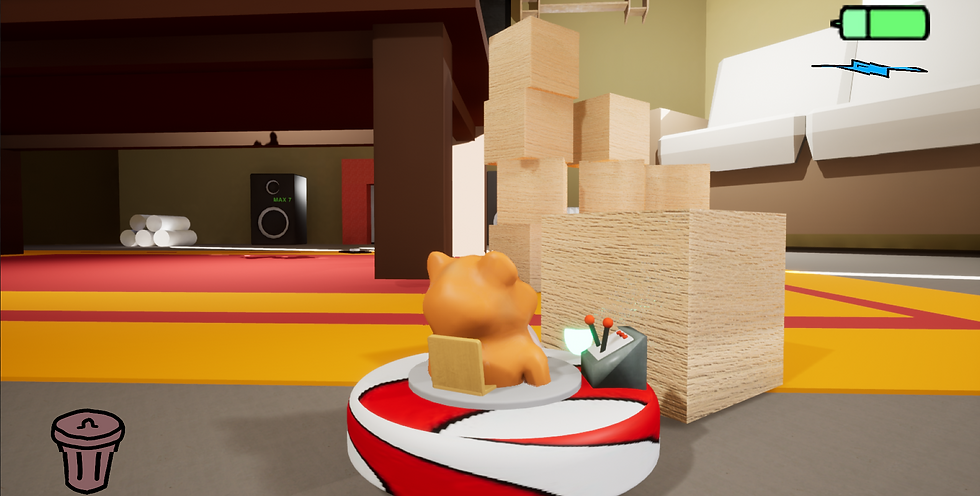
In the Project, we realized we needed a way in which the player would be able to access higher areas in order to get more action for the hamsters mobility. To solve this I made building blocks that the player could use to make a staircase for the hamster to jump on.

In order to push the blocks, you needed to use the Voomba to ram against them and move it to the direction you need it. This was done through the use of a collision box on each of the bottom blocks.
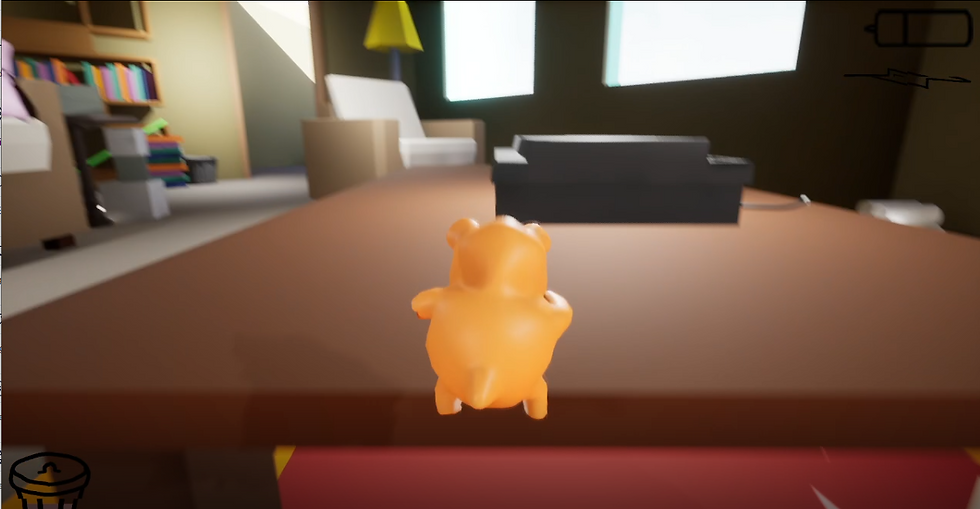
Once lined up you can jump up them with the hamster and beat up rats at the higher platforms.
Level Design Process:
Sketches
To begin creating the level, my co-level designer and I made a first draft of an outline of the level. After discussing with the group, we narrowed it down to just the family room, about 25% of the original map. It meant that the scope of the map was too enormous for the amount of time we had. In addition to scaling to the size of the hamster and Voomba, it was large enough.
Level Finish

During the implementation of the room there were multiple times in which I had to consider what to do with the amount of access space we would have in the room. Most of the time it would be taking time to discuss with the my fellow puzzle designer in order to fin ways to fill it in with content. Though when there were spaces that we could not fill, it helped me gain a good understanding how to know what parts of the level to focus and what parts could be easily removed.
Project Management Process:
For Clean Up Crew, I was placed in charge of managing the projects GitHub and making sure everyone's work was merged successfully and safely. During this time, the repository was split into everyone having their branch, and at the end of the day, I would have to make sure they all get pushed into the main through GitHub desktop or go onto the site to do it.
During my time managing the project, I encountered a few different challenges. I recorded them and how I fixed them in the table below:
Problem | How I fixed It |
One of our members was not pulling from main, and it reset the map on the level, losing a lot of progress |
|
One of our members Leo was trying to edit something they were not supposed to, resulting in it overwriting another partner's Payton's progress |
|
When trying to build the game for export playability, it refused to build the light successfully, and we could not export, let alone turn it in for some weeks. |
|
Biggest Take Aways | - I always check the level before pushing every merge commit to the main - Going into the actual Website usually operates a lot faster in terms of pull requests - Have a greater understanding of how to fit overwrite issues. - |


Comments